
Case study: AI Translate implementation
From this article, you will learn:
- How to build alignment with key stakeholders from day one — IT, legal, marketing teams, and product owners of global systems.
- Why a clearly defined business value (e.g. multi-million euro savings over two years) gives a project credibility and accelerates decision-making.
- How to plan and measure a Proof of Concept (e.g. user rating of 4.4/5, qualitative feedback, identification of weak points).
- How to launch different processes for individual departments during the pilot phase to test AI in diverse — including the most demanding — scenarios.
- Why success requires clear progress criteria and careful scaling instead of a global “big-bang” rollout.
When the client approached us — an international electronics manufacturer operating in dozens of markets — the question we heard was:
“Can AI significantly reduce translation costs?”
The scale was massive: hundreds of products, dozens of markets, millions of words per month.
The traditional model of working with language service providers meant costs measured in millions of euros per year.
This question became the starting point of our shared journey into implementing AI in translation. Instead of immediately thinking about another expensive enterprise-grade system, we looked for a way to prove the value of an AI-powered tool quickly and in a measurable way.
That’s how the project began — with a Proof of Concept delivered in two weeks, demonstrating potential savings of up to 99%, and then evolving step by step into a full production deployment.
AI as an alternative to traditional enterprise systems
Replacing traditional enterprise systems with AI-based solutions is not just a technology project. It is a transformation process that requires trust, change management (alignment), and continuous quality control.
Our experience with AI Translate — an internal translation tool we built for this client — shows that success requires both courage and pragmatism.
1. Build alignment from day one
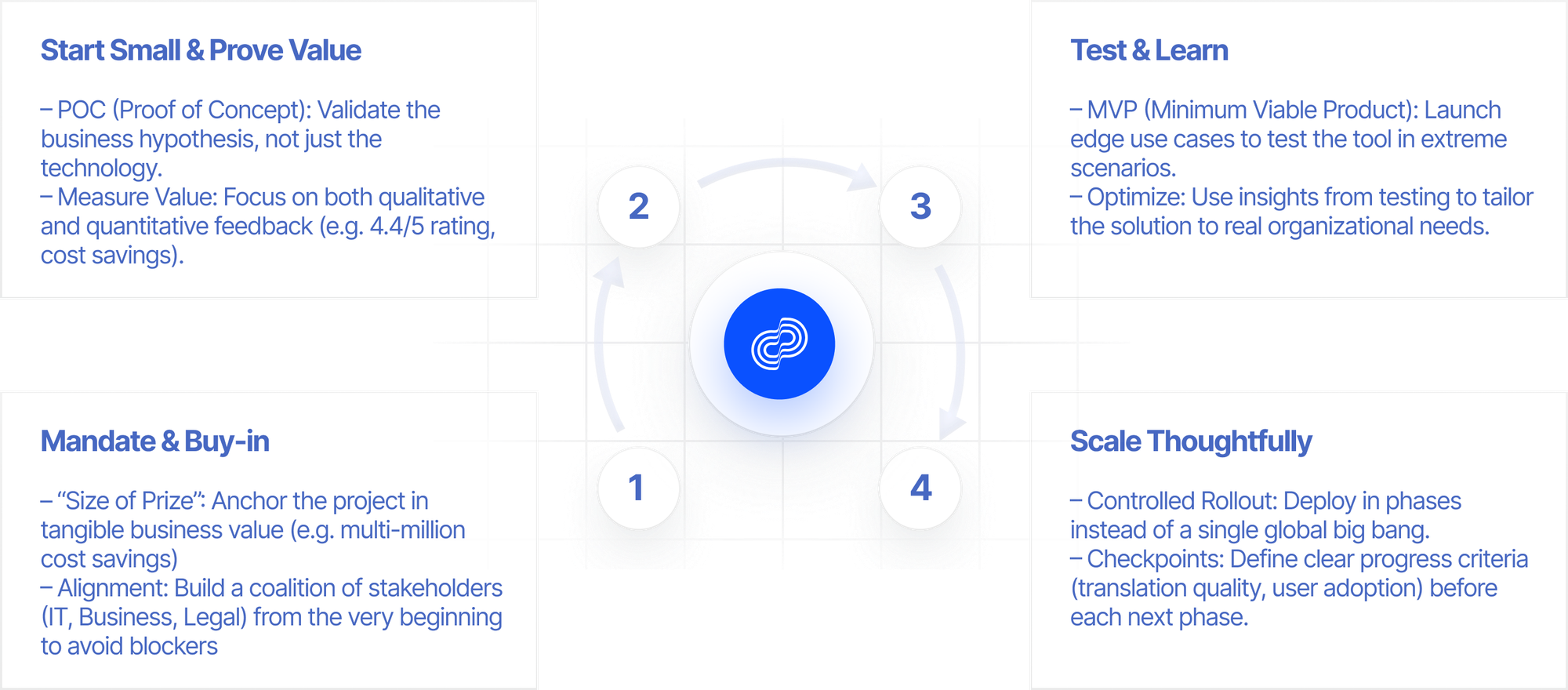
The key success factor in this project was involving the right people from the very beginning: IT teams (AI, cloud), global system product owners, legal teams, and key marketing stakeholders.
This helped us avoid later roadblocks and ensured that everyone understood both the potential and the limitations of the project.
The business value (“size of prize”) was clear to everyone from the start — in this case, multi-million euro savings over a two-year horizon. This created a strong mandate for the project and enabled fast decision-making.
The case in numbers:

2. Communication is your shield against risk
AI projects are full of unknowns and naturally raise concerns. Risks include, among others:
- output quality — AI can make mistakes, especially in specialist contexts,
- solution stability — will the system work reliably and remain controllable,
- user adoption — employees must trust the new tool,
- integration with existing systems,
- regulations and compliance — e.g. personal data (GDPR, AI Act).
Regular, proactive communication with the business, sharing progress, and maintaining an open feedback loop help minimize these risks and build trust.
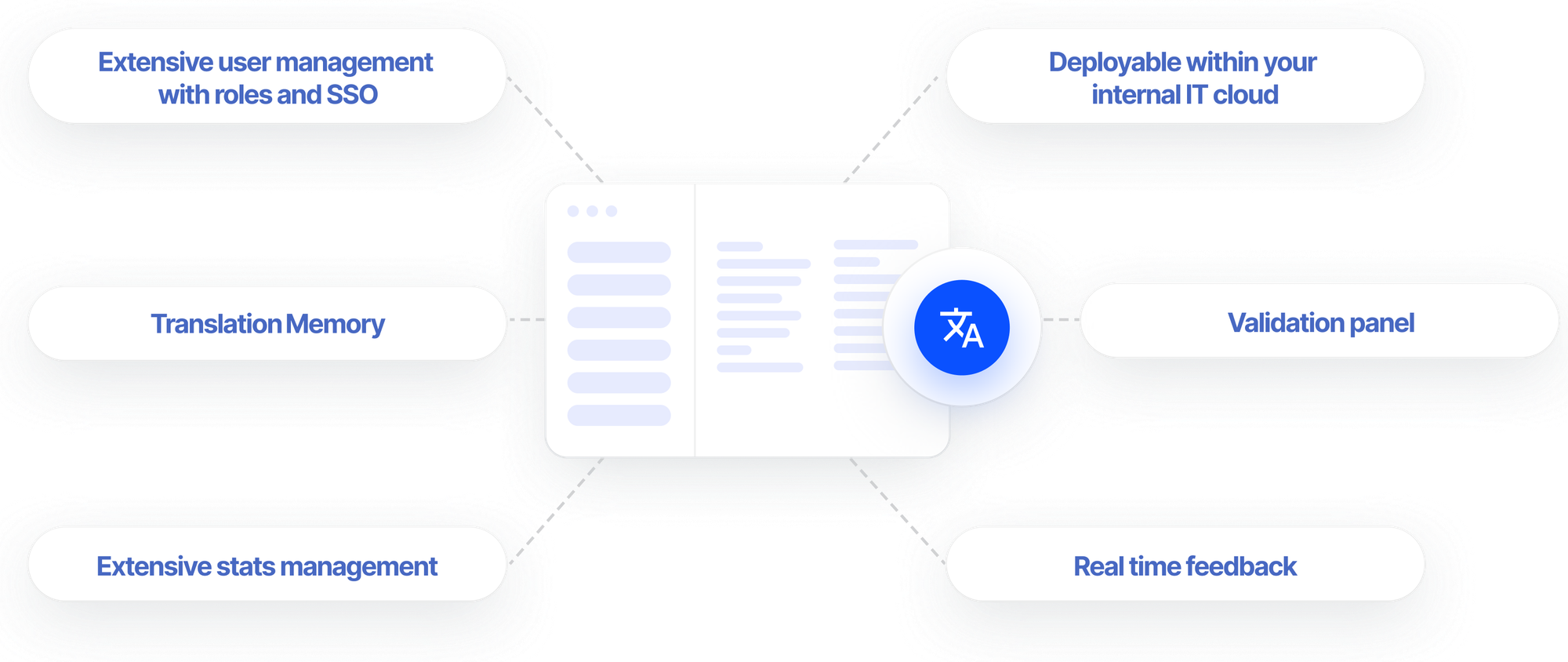
Examples of how we addressed security when implementing AI Translate
3. Start small — Proof of Concept
Don’t try to replace the entire infrastructure at once. A PoC shows whether AI delivers real value and where it generates the greatest savings.
In our case, the key PoC KPIs included:
- User satisfaction: target above 4.0 on a five-point scale — we achieved an average rating of 4.4.
- Qualitative feedback: conversations and workshops with users helped identify strengths and weaknesses.
- Identification of weak points: e.g. challenges with niche language pairs (such as Baltic languages) → defined as a development priority.
4. MVP — different workflows for different audiences
The Proof of Concept confirmed the initial assumptions, met KPIs, and generated strong expectations within the organization. Different teams working with translations on a daily basis began reporting their needs — which naturally led us into the MVP phase.
At the MVP stage, we did not limit ourselves to a single translation process. We launched multiple scenarios and workflows — for marketing teams, regulatory affairs, and customer care. This allowed us to:
- validate quality in extreme scenarios (edge use cases),
- test how AI performs across different formats and contexts,
- better adapt the tool to real organizational needs rather than only “ideal” cases.
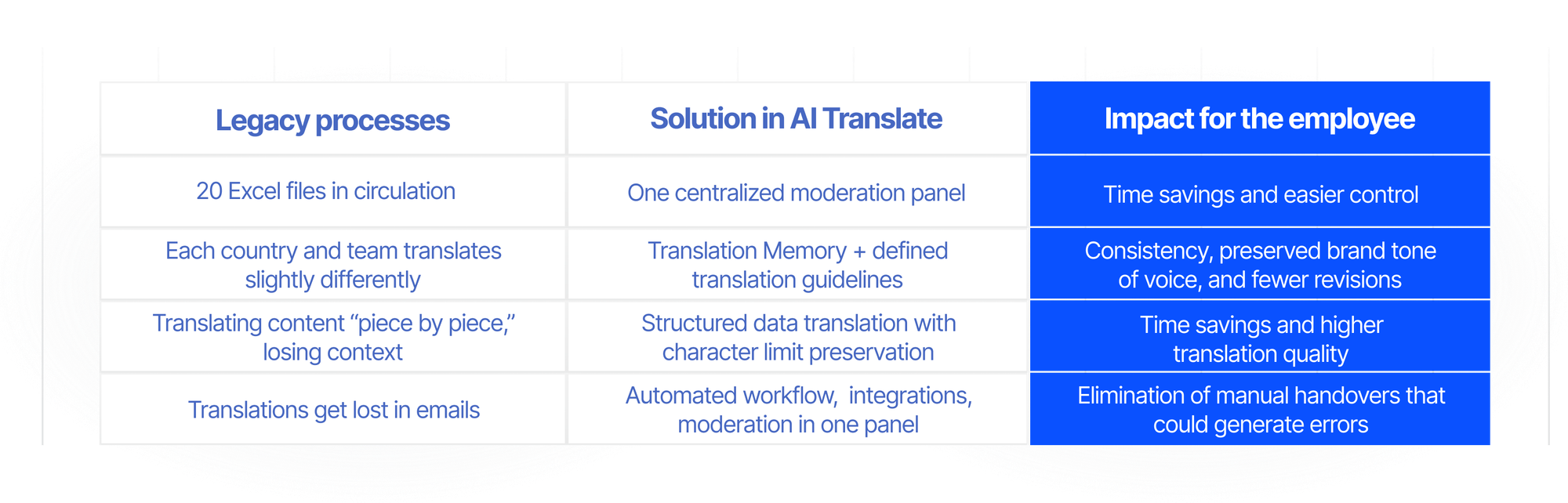
What do employees gain? Examples from the implementation
5. Scale carefully while controlling quality
Once a solution works in one area, it’s tempting to roll it out globally as fast as possible. But that is the easiest way to lose quality and trust.
A better approach is phased rollout — with clear quality checkpoints, user acceptance metrics, and training that supports the organization.
How to approach enterprise-scale AI implementation wisely? The deployment strategy we adopted
6. Clear progress criteria
From PoC to MVP, from MVP to global rollout — each stage must have clearly defined progress criteria. For AI Translate, these included:
- minimum translation quality (benchmarked against human translations),
- generated savings,
- acceptance of the tool by local teams.
Key takeaways from implementing AI in a large organization
- Change management: AI does not replace people — it changes their role. A transparent approach (“AI supports, humans decide”) increases adoption.
- Data security and compliance: the architecture must account for regulations (GDPR, AI Act).
- Measure not only ROI but also UX: without positive user experience, the project will not sustain itself.
- Think about scalability early: AI is “lightweight” at the start, but enterprise scale increases integration and maintenance requirements.
- Treat AI as a product, not a project: AI systems require continuous learning, updates, and a clear development roadmap.
Want to Talk About Your Processes?
At Shiftum, we help companies implement AI in translation processes. If you are wondering whether — and how — AI could help your organization, let’s talk with no obligation.
You share your processes, we share experience and ideas.
Then we assess whether we can build something valuable together.