For many years, we've been running a digital marketing agency. When ChatGPT came along, we bought access for the team. We expected faster work and better quality content. Instead, we got twenty different styles and results we couldn't control.
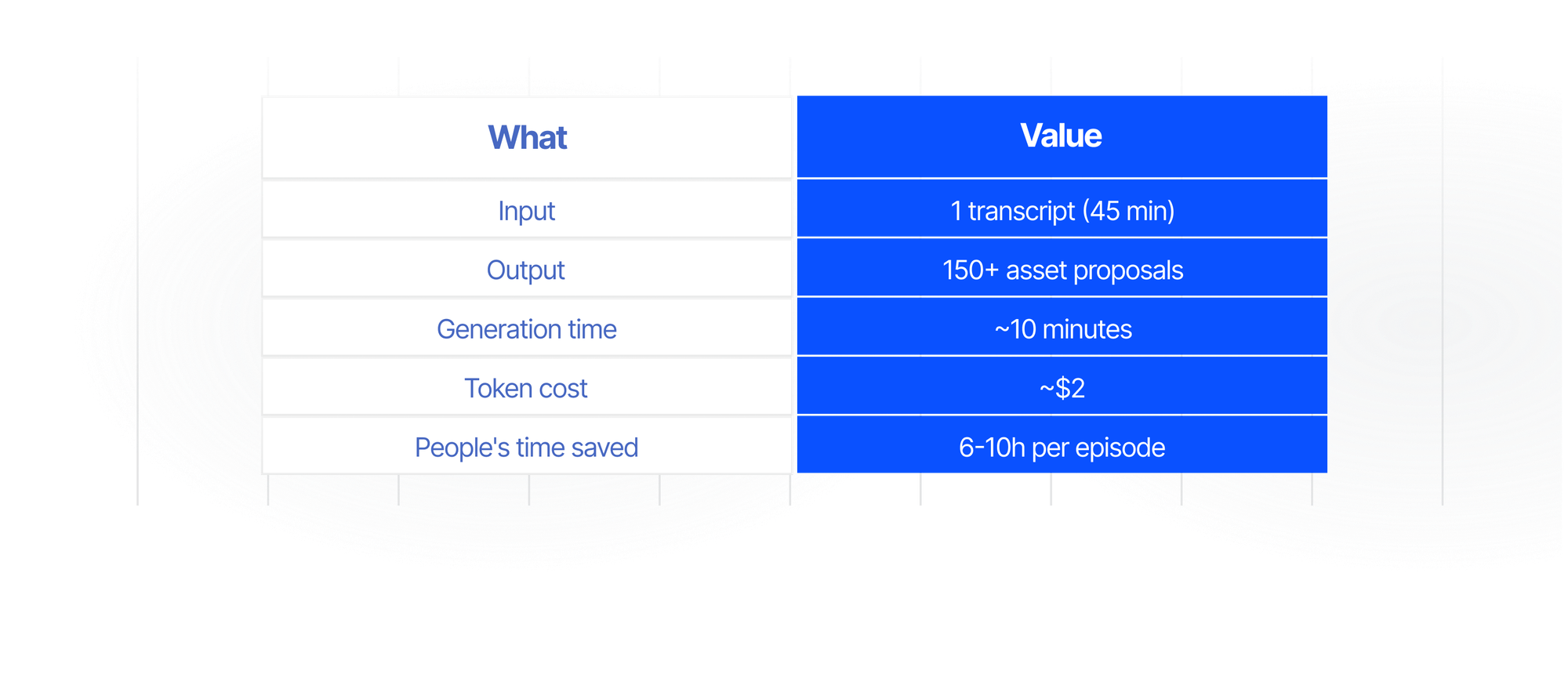
So we decided to approach this systematically. Over the past few months at Shiftum, we've been building an internal AI Content Engine - a system that generates over 150 content assets from a single source material in less than 10 minutes.
This article is a collection of lessons we learned along the way.
If you're managing content at a company with tens of thousands of SKUs and wondering whether AI can help generate content faster and better - this text is for you.
One Product, Dozens of Content Pieces
Selling and promoting a product online isn't just about a description and a few photos in your store. It's an entire ecosystem of content that needs to be created before a customer even sees your offer.
Let's take a simple example: dog food. To sell it online, you need:
- Product description for the store
- SEO title
- Meta description
- Tags and categories
- Alt descriptions for images
- Bullet points for Amazon (if you sell there)
- Social media posts
- Newsletter content
- Ad copy
So one product requires creating anywhere from a few to dozens of additional assets to support its visibility and promotion. Now multiply that by the tens of thousands of SKUs that an average online pet store carries.
That's incredibly difficult to do manually. At least not within a reasonable timeframe and budget.
The Solution That Doesn't Work
Most companies try the same thing we did: give the team access to ChatGPT and hope productivity shoots up.
And sure enough - every copywriter, marketer, and content manager starts using AI. The problem is that everyone does it their own way. They paste a command like "write me a product description for the store" into the chat window, add a PDF brochure or a spreadsheet with parameters, and expect a finished piece.
Sometimes it works satisfactorily. But usually not.
Why Chat + Manual Work Doesn't Lead to Better Results
There are several main reasons why a person working manually with an AI chat interface rarely achieves good results:
1. Not enough context for the model. AI gets bare technical parameters and is supposed to create an engaging description from that. It doesn't know the customer persona, the brand's tone of voice, doesn't know what problems the product solves. The result? Generic texts that could describe any dog food.
2. Cluttered context. The user dumps in a 100-slide product presentation because "everything's in there." They add a few more company presentations about clients and communication styles. AI processes it all, even though maybe 5 slides are important. The rest is noise that lowers the quality of responses. The result is very chaotic and often random content that may or may not meet user expectations.
3. Trying to take shortcuts. People assume that since they can go directly from a messy product sheet to a good e-commerce description in one work cycle, AI can too. It can't. AI is great at transforming content, but weak at creating complex materials from scratch. A typical model works best when guided through the generation process step by step - first a description template, then main points, then paragraph 1, and so on.
4. The speed vs. quality dilemma. This is where we get to the main scalability limitation. If you want to work fast (one prompt, shortcuts) - quality drops dramatically. If you want to work with quality (you guide the model step by step) - you need to prepare context so precisely and iterate so carefully that you don't increase content production scale. AI doesn't speed up work, it just moves it to a different place, which is usually the chat interface.
5. Losing context in long sessions. You try to generate all assets in one conversation and guide the model very precisely? You might find that after 6-7 iterations, AI starts internally compressing data from your conversation. As a result, the quality of subsequent generated elements drops because AI "forgets" your earlier agreements.
6. Repeating the process for every content type. Even if you have perfectly prepared context, for each new product you have to manually repeat the entire process. Some AI chat interfaces make this easier by creating "Projects" or "Gems," but each time it's still manual work. This approach doesn't scale well with thousands of products.
Conclusion
Chat plus manual process gives you a choice: either low quality or low speed. You can't have both.
The question is: is there another way?
There Is Another Way: 150 Quality Assets in Less Than 10 Minutes
At Shiftum, we're building an AI Content Engine - a system for producing content at large scale. I'll show you how it works using our own process as an example.
One of our clients runs a podcast as part of promoting their company. A typical episode is about 30-45 minutes of recording. Before we publish it online, we need to create many different assets: titles, descriptions, posts for various social media platforms, quotes, key takeaways, promotional materials, transcripts, chapters and timestamps, ideas for promotional reels, etc.
It used to take the team 8-12 hours to create a complete set of materials promoting one episode. Today? About 2-3 hours. AI system work cost: less than 2 dollars.
How It Works
About 30 specialized AI units work on each episode. We call them our "young, dynamic team of interns" ;) Such a team is typically built for a client's project and specialized in creating assets only for them.
Each "intern" has only one task and does it well because they have access to precise guidelines and source data. One extracts key quotes from the material. Another writes draft LinkedIn posts. Another prepares Instagram versions. Each generates several variants of their asset or ideas for communication.
People haven't disappeared from this process - they've changed roles. Instead of creating content from scratch, they evaluate the system's proposals, select the best variants, refine details, and plan publication.
The Numbers
What Changed
The team's work has undergone a fundamental transformation:
Before: Physically generating content from scratch. A copywriter sits, listens to the recording, reads the transcript, takes notes, writes posts.
Today: Quality oversight. A person reviews proposals, selects the best ones, corrects nuances, decides on publication. There are still a few assets we create manually from scratch, like blog posts based on episodes, but there are fewer and fewer of them.
This is an important distinction. We haven't fully automated publication - I don't think that would make sense in the near future. We've automated the most time-consuming part: first drafts.
The system's work results are qualitatively very close to what copywriters created from scratch on the same materials. The difference is that instead of 16 hours of work, we have 10 minutes of generation plus 2-3 hours of review, refinement, and planning.
Three Pillars of Creating Quality AI Content at Scale
Before you start using large language models to generate content at scale, you need to prepare three things. Without them, even the best AI model on the market will produce mediocre results.
1. Content Map and Quality Guidelines
Start with a simple question: what exactly are we creating for each product?
The store description is just the tip of the iceberg. Underneath are dozens of elements people often don't think about: SEO title, meta description, tags, alt descriptions for images, bullet points for marketplaces, variants for different social media channels.
Make a list. Literally. Write down every asset that gets created in the process of introducing a product for sale.
Then, for each element, document the quality requirements:
- How many characters?
- What structure?
- What headers?
- What format?
- What must it contain?
Here's where the first problem often appears: in most companies, these requirements aren't written down anywhere. Copywriters and editors intuitively know what a good asset and its components should look like. They do it well because they have experience. But that knowledge lives in their heads.
For AI to work well, you need to extract that knowledge and document it as detailed instructions. This is work you simply can't skip.
2. Brand Data Repository
Ask yourself: what would an intern need on their first day to create a given asset well?
The list usually looks similar:
- Detailed descriptions of customer personas
- Brand tone of voice (or for a specific product line)
- Examples of good materials to model after
- Information about what differentiates us from competitors
Companies often have these materials. The problem is they're old, not updated, scattered across different folders and documents. Or they exist only in the heads of people who've worked there for years.
Gather it in one place. Update it. Fill in the gaps. This will be your context repository - a knowledge base that AI will draw from for every generated element.
3. List of Intermediate Assets
This is the element most people skip - and that's why they get poor results.
Not everything can be generated directly from product data and rigid guidelines. Some things need to be created earlier to supplement the context of target assets.
Example: you want to generate a Facebook post about new dog food. You can feed AI product data and tell it to write a post. The result will be mediocre.
Better approach: first, based on the product and customer persona, generate 3-5 "theses" - communication angles that might interest a given target group. Let a person review and select and refine the best ones. Only then generate a draft post using the selected thesis as a starting point.
These "intermediate assets" can include:
- SEO keyword research from external tools
- Initial communication angles and marketing theses
- Competitive product analysis
- Extract of the most important product features for a specific persona
These aren't things that can be universally recorded in a knowledge repository and company guidelines. Each time they must be generated or checked dynamically, depending on context. It's also good practice to have them checked and refined by a person before they're used to generate target assets.
Final Step: Generating Quality Content
When you have these three things - an asset map with guidelines, a brand data repository, a list of intermediate assets - you can start building a system for generating content at large scale and very high quality.
The technical side of such a system is a topic for a separate article, but in short: it's about choosing the right models for different tasks, precisely building context for each asset type, and monitoring output quality.
Without the three foundations described above, no system will work well. With them - you have a solid base for scaling.
What We Learned
Building an AI Content Engine was a process of many trials and errors. Below is a list of several important things we discovered along the way.
1. Precision of Context > Amount of Context
When working with an LLM system, the first thought is usually: give AI as much information as possible. Throw in all the brand documentation, all the personas, the complete brand book. The more it knows, the better it will write.
That's a mistake, as I've written about before.
Lots of information in context creates noise. The model gets lost in information overload and produces mediocre results.
Better approach: instead of an entire, highly detailed persona description, we extract only the fragments that are relevant to the quality of a specific asset. If we're writing about customer challenges - we provide the challenges section. If we want to reference their hidden goals - we provide only those.
Result: cleaner context, better output. Bonus: lower token costs when creating content at scale.
2. Progressive Model Usage
Not all assets require the same level of model "intelligence" or "quality" per se.
That's why we built a three-tier system for created assets:
Tier 1: People. Main guidelines, strategy, key decisions - these are always made by people. AI won't replace strategic thinking. Some of the most important assets are also created from scratch by people.
Tier 2: Best models + verification. Materials supplementing context - communication theses, marketing angles, product analysis for a specific persona. We generate them with the best available models, and a person reviews and approves before use. The quality of intermediate assets and communication ideas directly translates to the quality of final content, so we don't leave these elements to chance.
Tier 3: Standard and smaller models. We generate final assets with different models, selected based on their capabilities and quality expectations for a given asset. In practice, this means using small models for simple assets like tags or SEO keywords, and slightly better models for communication content that people see.
This approach optimizes both quality and costs.
3. Intermediate Assets Are Key
The biggest quality breakthrough came when we started generating "intermediate" materials before actual content.
Static context data (personas, ToV, product information) isn't enough. You need dynamic elements - thoughtful theses, selected communication angles, information filtered for specific use.
These elements aren't static so they don't exist in documentation. They need to be generated specifically for a given product and a given persona. And give a person a chance to verify them before they go further.
Limitations of the Current AI Generation
Before we go further, an important caveat: this isn't a magic solution that eliminates all content production problems. The current generation of AI models has a number of limitations that directly affect this type of system.
1. AI Won't Replace People (Yet)
At least not in this generation of technology. The system does great at generating first drafts, but final quality decisions are made by people.
Someone needs to:
- Evaluate whether generated variants are at a sufficiently high level
- Choose the best communication direction
- Refine nuances and details
- Catch errors the model will miss
The nature of work changes, but people's work doesn't disappear.
2. It's Not "Set and Forget"
The system requires ongoing maintenance. Guidelines change. Perfect product descriptions and content formats evolve. Personas need updating. AI models develop and it's worth testing new ones.
If you leave this type of system without "care," quality will slowly decline.
3. Gradation of Automation
Not everything is suitable for full automation. Assets "invisible" to the customer - SEO tags, technical metadata - can be generated with less human oversight and automatically transferred to target systems, for example via API. But everything that directly affects brand perception - product descriptions, marketing communication - requires a human eye.
I'd be cautious about assuming it will be different in the foreseeable future. At least as long as you care about quality.
In Closing
Scaling content production with AI is possible. But it requires a change in approach.
Instead of giving people access to chat and hoping for a miracle, you need to:
- Map exactly what you're creating
- Build a brand knowledge repository
- Design a process with intermediate assets
- Consciously match models to tasks
- Leave room for human verification
It's not an easy path. But the results - 150 assets in 10 minutes instead of 12 hours of work - speak for themselves.
If you want to talk about how to approach scaling content in your company - reach out.