
In large organizations, content production is typically a bottleneck. One significant enough to delay campaign launches while teams wait for the content they need, or even limit expansion into new markets. Paradoxically, this often happens despite organizations investing in more and more AI content tools, hoping to streamline processes and boost productivity.
While the reasons can vary, one stands out to us as particularly important — most companies end up with separate tools for translation, separate tools for SEO, separate tools for social media, separate tools for e-commerce, and so on. Each one operates in isolation, with no knowledge of the brand or its business context, starting from scratch with every single task.
Before deploying an arsenal of tools to tackle individual tasks, we believe it's worth doing something more fundamental: building a shared foundation — an intelligence layer that accumulates knowledge about your company and powers all of your content processes that you choose to optimize with AI.
Why generic AI falls short
AI adoption in business has reached a point where most teams optimize their work by assembling their own stack — ChatGPT plus Zapier plus a handful of SaaS tools. At the team or individual task level, this makes a difference: some things get done faster, and people are freed from tedious manual work. That alone is genuinely valuable.
At the organizational level, however, these setups rarely deliver real impact. Not because the tools themselves are weak — it's more that they tend to boost individual productivity rather than company-wide performance, and they operate without organizational context, which can significantly reduce the quality of the content they produce. If you want to build that context, you have to hand-hold the AI model every time, feeding it all the necessary information from scratch. Every prompt starts at zero.
Because knowledge is never accumulated, you can't use it to improve the system over time — which means you lose the opportunity for continuous, compounding progress.
A shift in perspective: from individual tools to a system
How do you do it better? In our view, the key is a strategic shift in how you approach AI adoption. The typical starting point is asking which processes to optimize with AI and which tools and capabilities you'll need. Teams are encouraged to take initiative and streamline their work.
In content marketing, however, this approach can lead to chaos and a loss of consistency in brand communication. In our experience, it's also inefficient — both in terms of cost and quality.
We propose a different perspective: instead of asking which AI tools to use for specific tasks, ask what knowledge foundation you want to build so that any AI tool can perform well in your company's context.
This is what we call the Content Operating System — an operating system for all content marketing activities across the organization. It works much like the operating systems on our computers: a foundational layer on which individual tools run, with access to shared resources — brand knowledge, product data, market insights, content history, style guidelines, translation standards, and much more.
Content OS is a lasting company asset. It makes your organization independent of specific tools and platforms, which inevitably evolve and change over time. A well-built system ensures that any AI tool can work effectively within it, eliminating the need to start from zero every time.
How the Content Operating System works — three layers
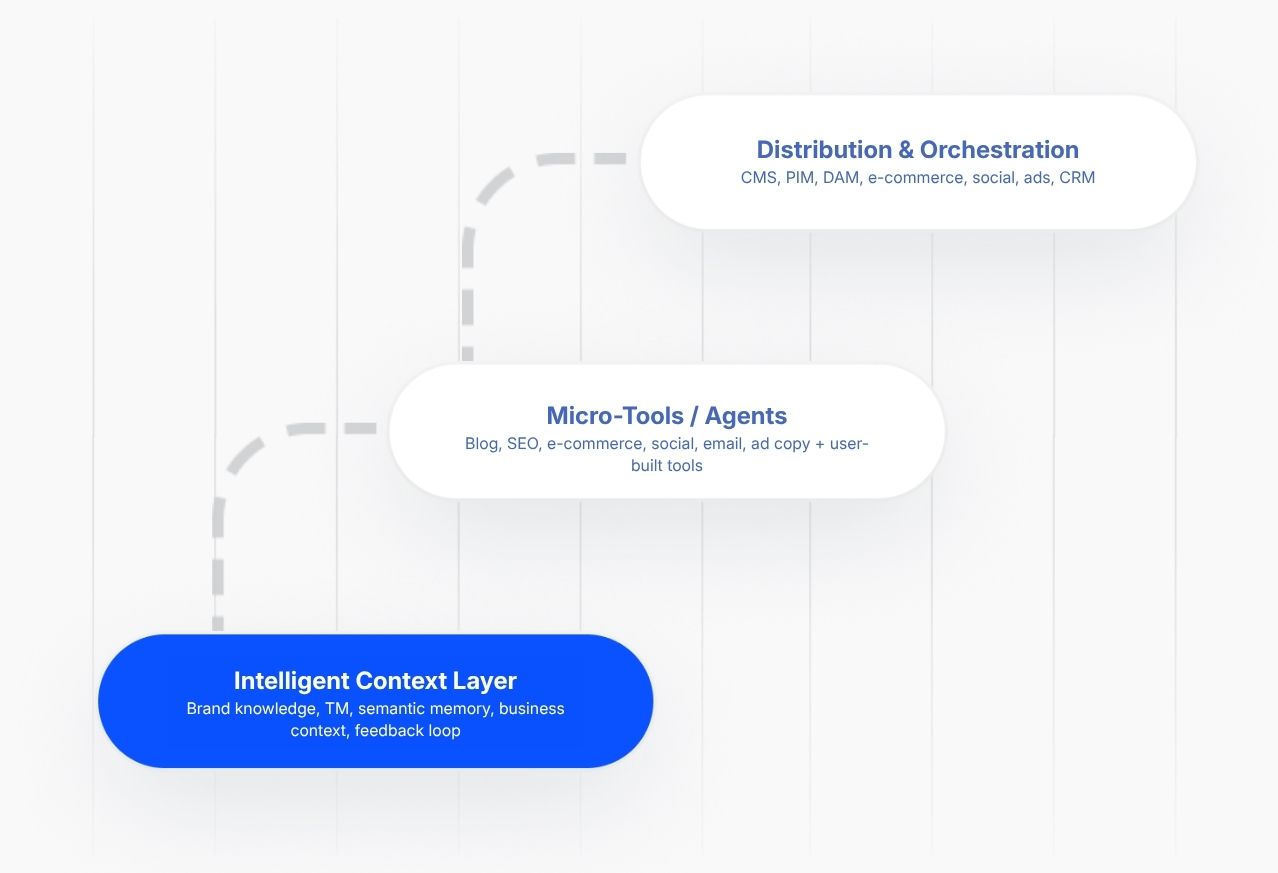
- Intelligent Context Layer — the foundation. This is where your organization's self-knowledge lives: brand knowledge (tone of voice, language, brand archetypes, communication style), product data, translation and semantic memory, and business context (sales seasonality, market priorities, compliance rules). This layer is built from source materials you feed into the system. It can also periodically pull and update data from external sources — for example, SEO keyword lists, ad platforms, or Amazon. The most important characteristic of this layer is that it continuously learns: every new piece of information, every correction, every moderator approval becomes input the system analyzes and uses to deepen its understanding of your company. This means quality improves over time, because the AI starts each task with richer and more accurate context.
- Micro-tools and agents — task execution. On top of the intelligence foundation, we deploy specific tools for specific tasks: product descriptions for e-commerce and marketplaces, website copy, social media posts, ad copy, emails, SEO content, how-to guides, and market-specific content localization. The key difference is that these tools no longer operate independently — they all draw from the Intelligent Context Layer through a defined set of interfaces, and the system delivers precisely the information each tool needs for a given task and context. The result is consistent output that scales without sacrificing quality. What's more, teams can build their own micro-tools (for example, a Black Friday promotion generator for DACH markets, or an Amazon bullet-point generator) using a no-code builder in a matter of minutes — and those tools benefit from the same shared knowledge base.
- Distribution and orchestration. The third layer connects everything with the systems where content is stored and managed: CMS, PIM, DAM, e-commerce platforms, social media, advertising, CRM. This eliminates the need to manually pass files between team members for review or publication. Information flows from the brief, through content generation, moderation, and approval, all the way to publication — and then performance data flows back into the Intelligent Context Layer, providing feedback and insights for future improvements.
How the Intelligent Context Layer delivers knowledge
It's worth pausing here to look more closely at how the Intelligent Context Layer works. Below is a simplified diagram showing the key areas of activity within this layer.
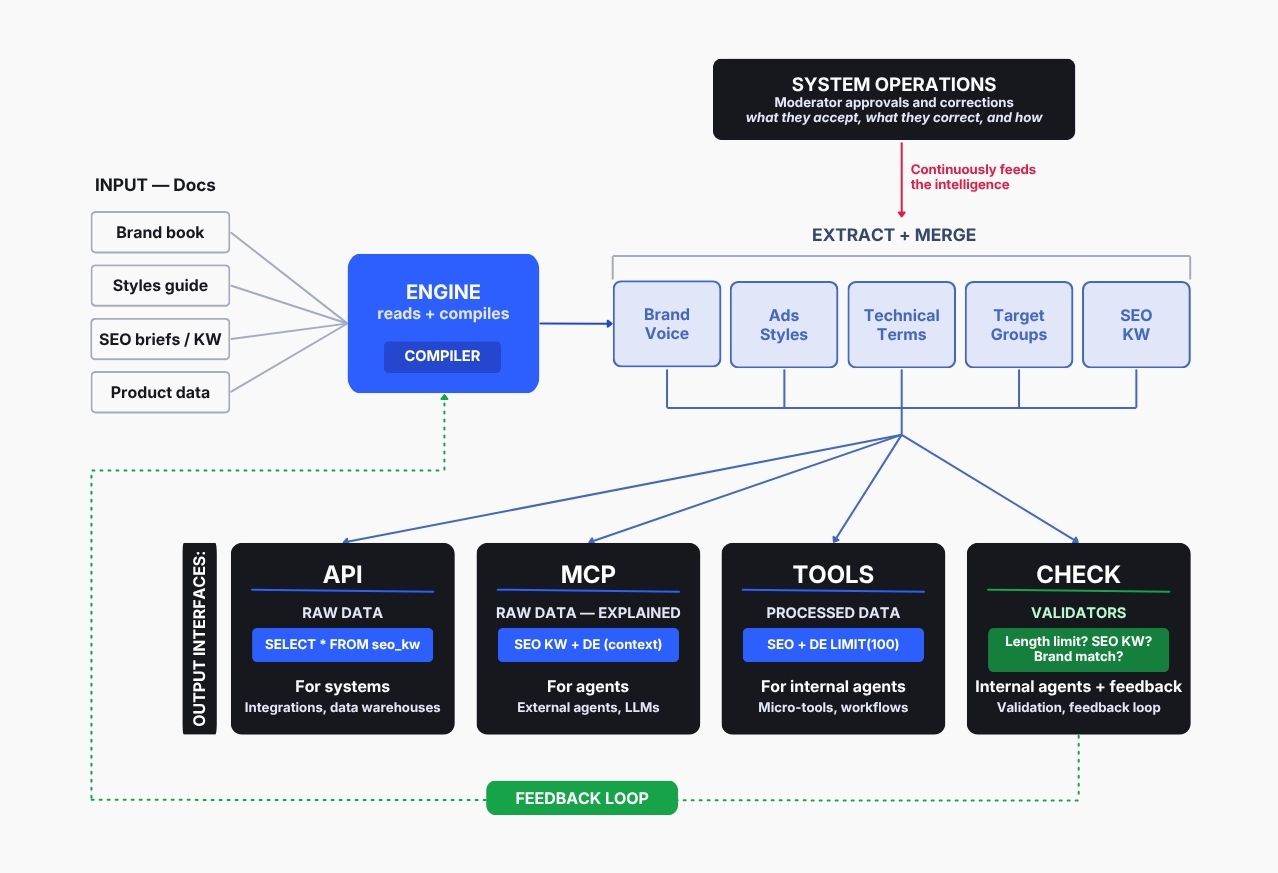
We can identify several specialized areas:
- Ingesting source data. This includes raw, unprocessed documents in various formats containing brand information, audience personas, brand books, sales presentations, product descriptions, catalogs, technical specifications, tutorials, keyword lists, and other data that matters to the organization. Data can also be pulled from external systems and updated on a regular basis (e.g., Google Keyword Planner, Ahrefs, and others).
- Reading and processing data (compiling). Source inputs are typically large documents containing a lot of information that shouldn't be passed wholesale into context (you don't want the model processing data it won't actually use). At this stage, files are read and compiled so that only the information relevant to the given context is extracted.
- Processed data is stored in a structured knowledge base. The database is organized by content-relevant categories — for example, brand voice, SEO keywords, technical terminology, target audiences, translation guidelines (the specifics vary depending on your needs). Only the information that matters is extracted from source materials and merged with what's already in the knowledge base.
- The knowledge base is also enriched by operational activity within the system. This could include, for example, corrections made by moderators, which — once properly processed — also feed into the knowledge base and contribute to institutional knowledge for future use.
- There are several ways to access the Intelligent Context Layer:
- API — raw data for systems (integrations, data warehouses, BI). Typically, these are technical queries like "retrieve all keywords for the DE market."
- MCP — raw data enriched with context, designed for external agents and large language models. Here, knowledge is delivered along with an explanation of why the data looks the way it does and how to use it.
- TOOLS — processed data for internal micro-tools and workflows. Most commonly, these are ready-made data packages tailored to a specific task, e.g., "the top 100 ranking keywords for category X in market Y."
- VALIDATORS — validation layers for internal agents. These enforce things like text length, keyword density, tone-of-voice compliance, and flagging content that requires legal review. Validation results feed back into the Intelligent Context Layer as input for future quality improvements.
This structure makes the system modular — you can add new micro-tools, channels, or integrations without rebuilding context from scratch every time. In addition, validators automate quality control: before any content reaches a human moderator, internal agents review it among themselves, significantly reducing the manual review workload.
What makes Content OS genuinely "intelligent"
There's a lot of hype around AI, and simply calling a system "intelligent" doesn't mean much on its own. So let's take a closer look at what specifically sets the Intelligent Context Layer apart from a standard knowledge base connected to an AI model.
A useful lens here is a concept recently proposed by Andrej Karpathy — the idea of an LLM-Wiki.
A traditional knowledge base (such as RAG) indexes what you feed into it: it stores, catalogs, and lets you search. The system Karpathy describes works differently — it compiles new knowledge with each new input (a presentation, an article, an instruction) and integrates it with what it already knows, accounting for contradictions and updating its earlier understanding of a given topic.
Think of it as the difference between a library and an editorial team: the library stores and retrieves content; the editorial team actively shapes it into a coherent whole based on the sources at its disposal.
Content OS works like an editorial team. When a new brand book arrives, for example, it isn't simply filed next to the old one or used to replace it — the system identifies what has changed and updates its brand knowledge accordingly. In practice, this means the quality Content OS delivers is a direct result of what it knows about your organization and how effectively it can make that knowledge available to each tool.
What this changes in practice — three scenarios
Scenario one: content needed right now
A manager in Poland urgently needs a product description for Allegro, a LinkedIn post, and a CRM email. In the typical workflow we see at most large organizations, this would require three different tools or agency briefs and take at least two days.With Content OS, the entire process can take no more than fifteen minutes. The manager prepares a brief with guidelines and sends it to the system. The micro-tools generate three consistent pieces of content, all aligned with brand communication standards. The manager reviews the AI-generated copy and publishes.
Scenario two: e-commerce at scale
The content team needs to prepare five hundred product descriptions for eight markets. Using traditional workflows, this can take weeks. Quality issues and localization errors are common, because the process involves many people — including external partners.With Content OS, this takes a few days — and more importantly, the tone of voice stays consistent across all markets, because every description in every language is created using the same system. It's as if you assigned the entire job to a single, well-trained specialist.
Scenario three: an always-on campaign
Imagine a campaign that distributes fresh content every week across social media, email, and advertising in a dozen or more markets. Running a campaign like this often proves impossible because content localization becomes the bottleneck.With Content OS, continuous publishing across all markets is no longer a challenge. A well-prepared campaign brief feeds the engine, and then micro-tools generate content variants for every format, channel, and market.
Governance and quality control: why we never deploy "unsupervised AI"
AI is undeniably a powerful tool, and when used properly, it can handle many tasks and deliver real business value. In our view, however, it is not — at this point — a tool that can operate without human involvement. The fundamental reason is that AI models are non-deterministic. You can never be 100% certain the AI will execute a task exactly as expected, following every guideline you've set.
Content OS significantly improves the quality, consistency, and compliance of AI-generated content. But caution and human oversight remain essential.
We typically recommend a three-tier autonomy model:
- Low-risk, high-volume content — AI generates and publishes independently (e.g., producing variants of descriptions for hundreds of SKUs).
- Medium-risk content — AI generates, a human approves (this applies to most marketing communication).
- High-risk content — requires a full legal/compliance review before publication (many brands choose not to use AI at all for this type of content).
We also always implement additional safeguards: version history, content lineage (who changed what and when), A/B variants, and rollback capabilities. Most importantly, the system's autonomy grows gradually, as more content is reviewed and approved by moderators. Only when the AI consistently delivers the expected quality is it possible to reduce oversight — for example, by allowing low-risk content to be published without prior human validation.
Where to start
We recommend thinking of Content OS adoption as a growth process — one where your organization gradually builds new capabilities over time. These things don't happen overnight, and this is no exception.
We propose a four-phase implementation approach:
- Phase 1 — Foundation. Build the Intelligent Context Layer: gather brand knowledge, integrate with core data sources (e.g., PIM, brand book, archived content, keyword databases, external sources like Amazon and ad platforms).
- Phase 2 — First tools. Select two or three use cases with the highest ROI potential and deploy tools for those alone. Collect early data on content quality, moderator corrections, and approval rates.
- Phase 3 — Scaling. Roll out the no-code builder to business teams — people start creating their own micro-tools without involving IT (or we build more advanced tools for teams on their behalf).
- Phase 4 — Multimodal. Expand content formats to include video, image, and voice.
The process may sound lengthy and complex, but in practice, a full-scale deployment can move quickly — within a few months. The timeline depends on organizational readiness, decision-making speed, and data availability. It's worth keeping in mind, though, that the real value of Content OS is long-term. Over time, it's entirely achievable for AI to produce content better than a new agency or a recently hired copywriter — regardless of which tool you use.
Summary
Brand content is a strategic asset that often determines competitive advantage. At scale, however, it can become a bottleneck — creating and localizing content across markets is time-consuming and expensive. It's no surprise, then, that with the rise of generative AI, most organizations already use large language models to speed up content production.In our view, though, using AI tools in a fragmented way isn't enough to generate real value and consistent quality across the organization. What's needed is a foundation underneath those tools — an Intelligent Context Layer — capable of powering all content processes, significantly improving both the consistency and quality of the results.
If this topic resonates with you — let's talk.